
Brief
Shotgun Shell Types: Pick the Right Load Every Time
Discover the essential shotgun shell types, their uses, and how to choose the right load for any hunting situation. Safety tips included!
Shotgun shells generally fall into three main categories: birdshot, buckshot, and slugs. Birdshot is used for small game and clay targets. Buckshot is suitable for close-range hunting of larger game and for home defense. Slugs are typically chosen when a single projectile is needed for longer range or big game. Understanding this framework helps clarify subsequent details.
Safety first: Always match the shell’s gauge and length to your firearm’s chamber rating before loading.
Key Takeaways
Matching shell type to use case is the single most important decision a shotgun shooter makes — birdshot for birds and clays, buckshot for close-range defense and deer, slugs for big game and longer shots.
| Point | Details |
|---|---|
| Three shell categories | Birdshot, buckshot, and slugs each serve a distinct purpose; mixing them up costs performance and can create safety issues. |
| Chamber compatibility | Never fire a shell longer than your barrel’s chamber rating — it creates dangerous pressure spikes. |
| Shot size scale | Larger shot-size numbers mean smaller pellets; No. 9 yields roughly 576 pellets per ounce vs. about 221 for No. 6. |
| Non-toxic shot rules | Federal law requires non-toxic shot for waterfowl; steel, bismuth, and TSS are the legal alternatives to lead. |
| Blvista for supplies | Blvista stocks shotgun ammunition and reloading powders like Accurate Nitro 100 NF for shooters who want reliable components. |
Table of Contents
- What are the main shotgun shell types and how do they work?
- How do birdshot, buckshot, and slugs compare?
- What do gauge, shell length, and shot size numbers actually mean?
- How do patterning and choke affect your effective range?
- Which shell should you choose for hunting, sport, or home defense?
- What safety and legal rules apply to shotgun ammo in the U.S.?
- What most shooters get wrong about shell selection
- Blvista has the ammo and reloading supplies you need
- Sources
- FAQ
What are the main shotgun shell types and how do they work?
A shotshell is a self-contained cartridge that holds a primer, propellant powder, a wad, and either a payload of pellets or a single slug, all sealed inside a plastic or paper hull with a brass base. Understanding each component tells you why the markings on the box matter.
The five components:
- Primer: A small impact-sensitive charge seated in the base; the firing pin strikes it to start the ignition chain.
- Powder: The propellant charge that burns rapidly and generates gas pressure to push the payload.
- Wad: A plastic or fiber cup that seals the bore, protects the shot from barrel friction, and separates the powder from the payload.
- Payload: Either a charge of pellets (shot) or a single slug.
- Hull: The outer case, usually plastic with a brass or steel head, that holds everything together and seals the chamber on firing.
The firing sequence:
- The firing pin strikes the primer.
- The primer ignites the powder charge.
- Rapidly expanding gas pushes the wad and payload down the barrel.
- The wad separates from the shot (or slug) at or just past the muzzle.
- Shot spreads into a pattern; a slug continues as a single projectile.
Per SAAMI-recognized standards, shotshell maximum average pressures run roughly 11,000–14,000 psi, far below most centerfire rifle loads, and muzzle velocities typically fall between 900 and 1,500 fps depending on the load.
What to check on the box before you buy:
- Gauge (12, 20, 0.410, etc.)
- Shell length (2 3/4", 3", or 3 1/2")
- Shot type (lead, steel, bismuth, TSS) or slug designation
- Shot size (No. 9, No. 6, 00 buck, etc.) or slug weight in ounces
How do birdshot, buckshot, and slugs compare?
Each shell type solves a different problem. Birdshot puts a dense cloud of small pellets on a fast-moving target. Buckshot delivers fewer but much heavier pellets with serious terminal energy at close range. Slugs trade pattern spread for single-projectile precision and reach.
Birdshot in practice: No. 7.5 and No. 8 are the standard for sporting clays and skeet. No. 6 works well for pheasant and other upland birds. No. 4 is a common choice for turkey at moderate distances, though dedicated turkey loads often step up to heavier payloads.
Buckshot in practice: 00 buck (pronounced “double-ought”) is the most widely used defensive and deer-hunting load in 12 gauge, typically packing 8–9 pellets per shell. No. 4 buck carries more pellets at smaller diameter and is popular for deer in dense brush. Buckshot is the preferred choice for home defense because of its terminal performance at close range; slugs are reserved for situations requiring deeper penetration or greater distance, though overpenetration is a real concern with both.
Slug types: Foster slugs (rifled slugs) are designed for smooth-bore barrels. Sabot slugs use a plastic sleeve to engage rifled barrels and deliver better accuracy at longer range. If your shotgun has a rifled barrel, use sabots; if it’s smooth-bore, stick with Foster slugs.
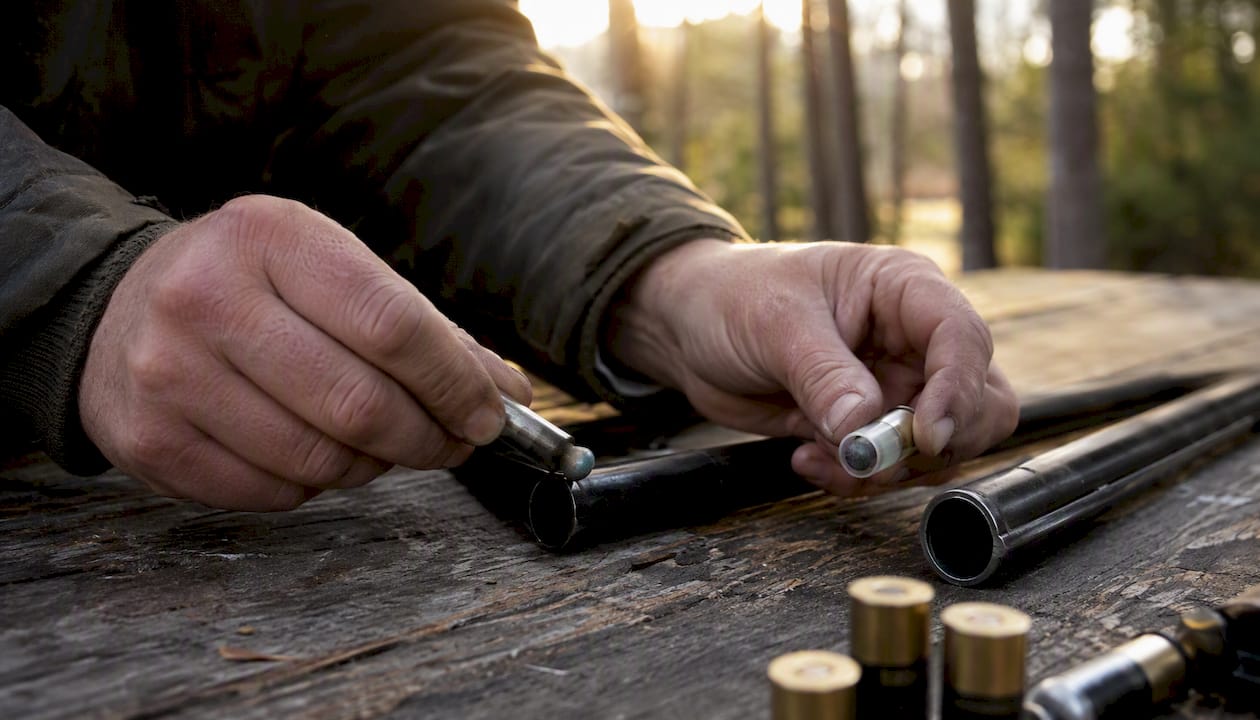
Pro Tip: When hunting waterfowl or near wetlands, lead shot is prohibited by federal law. Steel, bismuth, and tungsten/TSS are the legal alternatives. Steel is the most affordable but patterns differently than lead, so match your choke accordingly — more on that below.
What do gauge, shell length, and shot size numbers actually mean?
The core rule: a smaller gauge number means a larger bore. A 12 gauge barrel is wider than a 20 gauge, which is wider than a 28 gauge. The 0.410 is the exception — it’s named for its actual bore diameter in inches (0.410"), not a gauge number.
Gauge is historically defined by the number of pure lead balls of that bore diameter that equal one pound. Twelve balls of 12-gauge diameter weigh one pound. That’s why 12 gauge is bigger than 20 gauge.
Shell length on the box refers to the hull’s length after firing, when the crimp has opened. An unfired 2 3/4" shell is physically shorter than 2 3/4" until it’s fired. You can safely fire shorter shells in a longer chamber, but firing a longer shell in a shorter chamber is a serious safety risk — it can cause dangerous pressure spikes. Check your barrel’s chamber rating stamped on the receiver or barrel before buying ammo.
Shot size works in reverse: larger numbers mean smaller pellets. No. 9 is tiny; No. 2 is noticeably larger. Buck sizes flip the convention: 4 buck is smaller than 1 buck, and 00 buck is larger than 0 buck. According to American Rifleman’s shotshell ballistics data, No. 9 lead shot yields roughly 576 pellets per ounce, while No. 6 drops to about 221 pellets per ounce. TSS (tungsten super shot) is denser than lead, so you can use smaller pellets and still get the same energy, which changes the pellets-per-ounce count significantly.
How to read a shell box safely:
- Confirm the gauge matches your firearm exactly.
- Check the shell length against your chamber rating — never exceed it.
- Identify the shot type (lead, steel, bismuth, TSS) and confirm it’s legal for your hunting scenario.
- Note the shot size or slug weight and match it to your intended use.
- Look for any velocity or dram-equivalent markings if recoil matters to you.
How do patterning and choke affect your effective range?
Choke and patterning determine whether your shot charge actually hits the target. A tighter choke constricts the muzzle, keeping pellets together longer and producing a denser pattern at distance. A more open choke lets the pattern spread faster, which helps at close range.
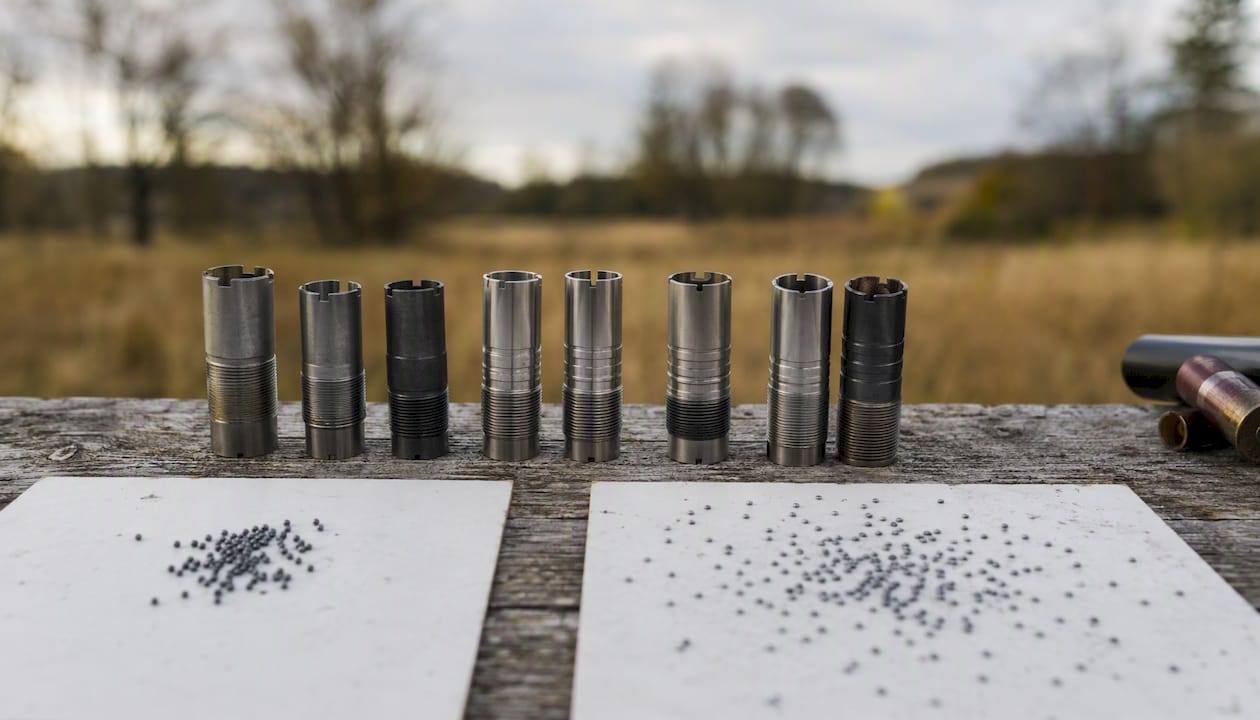
The four most common choke types, from most open to tightest: Cylinder (no constriction), Improved Cylinder, Modified, and Full. Cylinder and Improved Cylinder work well for close-range birds and home defense. Modified is a versatile all-around choice for upland hunting. Full choke is standard for turkey and long-range clay games like trap.
How to pattern-test your shotgun:
- Set up a large paper target (at least 30" × 30") at a measured distance — 25 yards for most hunting loads, 40 yards for turkey or trap loads.
- Fire 3–5 rounds from a stable position, one shot per fresh target sheet.
- Draw a 30" circle around the densest part of each pattern.
- Count the pellet strikes inside the circle and note any gaps large enough for a bird or target to slip through.
- Compare results across choke/load combinations to find the most consistent pattern for your application.
Practical pattern testing like this, firing multiple rounds at paper targets and counting pellet strikes, is the only reliable way to know how your specific gun, choke, and load combination actually performs.
Pro Tip: Steel shot patterns differently than lead because it doesn’t deform in the barrel. Use a more open choke (Improved Cylinder or Modified at most) with steel to avoid dangerous pressure buildup and to get a usable pattern. Never run steel through a Full choke unless it’s specifically rated for steel.
Which shell should you choose for hunting, sport, or home defense?
Match the shell to the job. For hunting, the target species and distance drive the decision. For sport shooting, the game format and distance determine the load. For home defense, terminal performance at close range and overpenetration risk are the two factors that matter most.
| Scenario | Recommended Shell | Why |
|---|---|---|
| Upland birds (pheasant, quail) | 12 or 20 ga, No. 6 or No. 7.5 lead/steel | Dense pattern at 20 yards |
| Waterfowl | 12 ga, No. 2 or BB steel/bismuth | Non-toxic required; larger pellets compensate for steel’s lower density |
| Deer in open fields | 12 ga slug (sabot for rifled barrel) | Single projectile, 75–100 yard accuracy |
| Deer in dense brush | 12 ga 00 or No. 4 buck | Short shots, multiple pellets increase hit probability |
| Sporting clays / skeet | 12 or 20 ga, No. 7.5 or No. 8 | Small pellets, high count, close-range targets |
| Home defense | 12 ga 00 buck or reduced-recoil buckshot | Terminal performance, manageable pattern at indoor distances |
| Rural/outdoor defense | 12 ga slug or 00 buck | Greater range or barrier penetration when needed |
Overpenetration in home defense: 00 buck can penetrate multiple interior walls. Reduced-recoil buckshot loads and No. 1 buck are worth considering if wall penetration is a concern in your home layout. Birdshot is not recommended for home defense — at typical indoor distances it may not reliably stop a threat.
Can you use birdshot for home defense? Technically yes, but it’s not advisable. Birdshot lacks the penetration depth to reliably reach vital structures on a determined attacker, especially through heavy clothing.
Slug vs. buckshot for woods deer hunting: Use buckshot when shots are under 40 yards in thick cover where multiple pellets improve hit probability. Switch to a slug when you have clear lanes and shots out to 75–100 yards, where a single accurate projectile outperforms a spreading pattern.
For self-defense ammo selection and rotation guidance, it’s worth reviewing your defensive load periodically to confirm it still fits your setup and local conditions.
What safety and legal rules apply to shotgun ammo in the U.S.?
Match your gauge and chamber length every time. That single habit prevents the most common ammunition-related accidents. Beyond that, a few legal and handling rules directly affect which shells you can buy and use.
Storage and handling checklist:
- Store ammunition separately from firearms in a cool, dry location away from heat sources.
- Keep shells in their original boxes or labeled containers — loose mixed ammo is how gauge mismatches happen.
- Inspect shells before loading; discard any with dented hulls, corroded primers, or visible damage.
- Never fire a shell longer than your chamber’s rated length.
- Treat every loaded shell as live until you’ve confirmed it’s been fired or removed.
- After a defensive shooting, know who to contact and what steps to take before handling evidence.
U.S. legal considerations: Federal law under the Migratory Bird Treaty Act requires non-toxic shot (steel, bismuth, or tungsten-based) for all waterfowl hunting nationwide. Many states extend non-toxic requirements to additional species and public lands. Check your state fish and wildlife agency’s current regulations before each season, and consult NSSF safety and regulatory resources for updated guidance. SAAMI sets the technical standards for chamber pressures and shell dimensions that manufacturers follow — understanding those standards helps you avoid overpressure loads.
Firing a shell longer than your barrel’s chamber rating is not just a performance issue. It’s a safety hazard that can cause dangerous pressure spikes and potential firearm failure.
This article provides general information about shotgun ammunition. Always confirm current federal and state regulations with the relevant agency or a qualified professional before hunting or carrying defensively.
What most shooters get wrong about shell selection
Most people overthink the birdshot-vs-buckshot decision and underthink the gauge-and-chamber question. The shell type matters, but a gauge mismatch or a shell that’s too long for your chamber is the actual danger. Get the compatibility right first, then optimize for performance.
The other thing worth saying plainly: smaller-framed shooters and youth shooters don’t need to start on 12 gauge. 20 gauge and 0.410 produce noticeably less felt recoil because they carry smaller powder charges and lower payload weights. A shooter who flinches from recoil will pattern worse with a 12 gauge than they would with a well-fitted 20 gauge. Fit and recoil management matter more than raw gauge size for most hunting and sport applications.
On the defense side, the conventional wisdom that “any shotgun load stops a threat” is worth questioning. Birdshot at close range can cause serious wounds but may not reliably stop an attack. Buckshot, particularly 00 or No. 1 buck, is the load that consistently performs in defensive scenarios. Slugs are a legitimate option in rural settings where range or barrier penetration matters, but they demand more precise shot placement and carry significant overpenetration risk indoors.
Pro Tip: If recoil is a concern, try reduced-recoil 12 gauge buckshot loads before switching gauges. They cut felt recoil noticeably while retaining the terminal performance of standard buckshot.
Blvista has the ammo and reloading supplies you need
Whether you’re stocking up on defensive buckshot, hunting loads for the upcoming season, or building your own shells from scratch, Blvista carries the ammunition and reloading components to cover it. The selection includes shotgun-specific powders like Accurate Nitro 100 NF in 8 lb jugs for reloaders who want consistent, clean-burning performance across a range of shotshell loads, as well as a 4 lb option for smaller-batch reloading. Browse the full inventory, check current stock, and get your order fulfilled fast with support from specialists who know the gear.
Sources
- Shotgun Basics: 3 Types of Shotshells (& Why It Matters) | NRA Family
- How Shotgun Shells Work and How to Choose the Right One | LetsGoShooting
- Shotshell basics: Understanding payloads, pressures and performance | American Rifleman
- Understanding shotgun shells | Guns & Ammo
- Shotshell ammo jargon buster: dram equivalent, shot buffer and 40 other terms | MyGunDeal
Use SAAMI for chamber and pressure limits, NSSF for current non-toxic shot regulations, and the NRA Family and American Rifleman resources for load selection and ballistics guidance.
Recommended
FAQ
The three main shotgun shell types are birdshot, buckshot, and slugs. Birdshot carries many small pellets for birds and clays, buckshot uses fewer larger pellets for deer and defense, and slugs fire a single projectile for big game or longer-range shots.
Most law enforcement agencies issue 00 buckshot as the standard shotgun load because of its close-range terminal performance. Slugs are carried as a secondary option for situations requiring greater penetration or distance, but buckshot is the primary defensive choice.
The 2 3/4" 12 gauge shell loaded with 00 buckshot or No. 7.5 birdshot covers the widest range of uses and is the most widely stocked load in the U.S. For sport shooting, No. 7.5 or No. 8 target loads dominate; for defense and deer, 00 buck is the standard.
A 12 gauge shell carries a larger payload and more powder than a comparable 20 gauge load, which translates to more energy downrange and more felt recoil. The 20 gauge is a capable hunting round, but the 12 gauge delivers more pellets or a heavier slug at any given distance.
Birdshot is not recommended for home defense. At close range it can cause serious injury, but it lacks the penetration depth to reliably stop a threat. Buckshot, particularly 00 or No. 1 buck, is the standard recommendation for defensive shotgun use.
Was this useful?