
Brief
The FFL Transfer Process: A Step-by-Step 2026 Guide
Discover the essential steps for a seamless FFL transfer process in 2026. Ensure your firearm purchase complies with federal laws today!
An FFL transfer is the lawful movement of a firearm through a federally licensed dealer. Federal law requires it for virtually every retail purchase and all interstate shipments. Here is the five-step sequence every buyer needs to follow:
- Choose and confirm a receiving FFL dealer.
- Have the seller ship the firearm to that FFL.
- Go to the dealer, complete ATF Form 4473, and show government-issued photo ID.
- The dealer contacts NICS for a background check.
- Once cleared, pay the transfer fee and take possession.
The two governing authorities are the Bureau of Alcohol, Tobacco, Firearms and Explosives (ATF) and the FBI’s National Instant Criminal Background Check System (NICS). Dealers who skip required background checks or falsify records risk license revocation.
Pro Tip: Get the dealer’s default-proceed policy in writing before the seller ships. A quick text or email confirmation takes two minutes and prevents a frustrating surprise at pickup.
Key Takeaways
The FFL transfer process requires a licensed dealer, ATF Form 4473, a NICS background check, and valid government-issued photo ID at every stage, with timelines ranging from minutes to 10 business days depending on the NICS response and your state’s rules.
| Point | Details |
|---|---|
| FFL transfer definition | Any firearm moving through a licensed dealer requires this process, including all interstate shipments. |
| Documents to bring | Valid government-issued photo ID; state permit if your state uses one as a NICS exception. |
| Who pays transfer fees | The buyer pays in standard practice; confirm the fee in writing before the firearm ships. |
| NICS timing rules | Proceed clears in minutes; Delayed allows up to 3 business days (up to 10 for under-21 buyers) before default-proceed applies; one check is valid for 30 days. |
| Blvista’s role | Blvista ships directly to your receiving FFL with full tracking and upfront fee disclosure, simplifying the transfer from order to pickup. |
Table of Contents
- What to bring, who pays, and how long it takes
- How does the FFL transfer process start? Choosing your dealer
- How does interstate shipping work for an FFL transfer?
- What paperwork do you complete at pickup?
- What happens during the NICS background check?
- Step 5: completing the transfer, paying fees, and dealer recordkeeping
- Special cases: NFA items, state permits, private sales, and waiting periods
- If you’re delayed, denied, or the dealer refuses — what to do next
- Common mistakes that slow or stop transfers
- What Blvista sees customers get wrong — and how to avoid it
- Blvista makes the FFL transfer process straightforward
- Sources
- FAQ
What to bring, who pays, and how long it takes
Documents and ID
Most dealers require:
- A valid, unexpired government-issued photo ID (driver’s license, state ID, or U.S. passport)
- Any state-issued firearm purchase permit if your state uses one as a NICS exception
- The seller’s shipping confirmation or invoice (not legally required, but useful for matching the firearm to your order)
Transfer fees and who pays
Transfer fees are almost always paid by the buyer. Industry practice puts the range between low tens to less than one hundred dollars per firearm for a standard handgun or long gun, though some dealers charge more for NFA items or out-of-state transfers. Nothing in federal law caps the fee or assigns it to either party, so if a seller agrees to cover it, get that in writing before the gun ships.
Timeline from shipment to pickup
| Stage | Typical Duration |
|---|---|
| Seller ships to receiving FFL | 1–5 business days (carrier dependent) |
| NICS check: Proceed | Minutes to same day |
| NICS check: Delayed | Up to 3 business days (up to 10 for buyers under 21) |
| State waiting period (where applicable) | varies by state |
| Pickup after NICS clears | Same day in most cases |
NICS response types at a glance:
- Proceed: Transfer is authorized. The dealer can complete the transaction immediately.
- Delayed: The FBI needs more time. The dealer may transfer after 3 business days without a “Denied” response (or up to 10 business days for buyers under 21 with qualifying juvenile records, through September 30, 2032), per 27 CFR § 478.102.
- Denied: The dealer must refuse the transfer. The buyer receives the NICS Transaction Number (NTN) and can file an appeal.
Most checks clear in minutes. Delays are the exception, not the rule, though high-volume periods can slow FBI review.
How does the FFL transfer process start? Choosing your dealer
Before anything ships, you need a confirmed receiving FFL. Skipping this step is the single most common cause of returned shipments and wasted money.
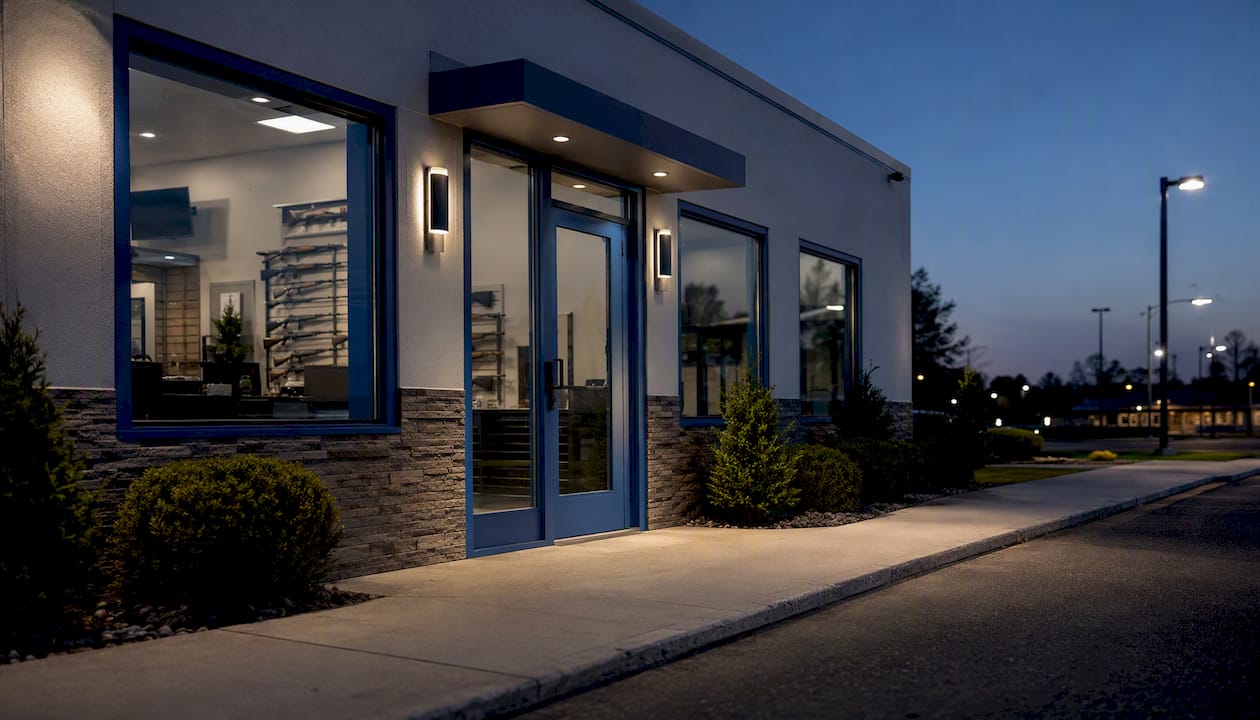
Verifying an FFL dealer
Use the ATF’s FFLEZCheck tool to confirm a dealer’s license is active before you hand their information to the seller. An expired or revoked license means the seller cannot legally ship to them, and you could be on the hook for return-shipping costs.
Questions to ask before the gun ships
- Do you accept transfers from out-of-state sellers?
- What is your transfer fee, and does it cover NFA items?
- Do you require an appointment for pickup?
- Do you apply the federal default-proceed after three business days, or do you wait for an explicit “Proceed”?
- What happens if the package arrives damaged or the serial number doesn’t match the paperwork?
If a dealer refuses a transfer after the firearm has already shipped, the seller typically bears return-shipping costs, but that varies by seller policy. Confirming the receiving FFL’s willingness to accept the transfer before the gun leaves the seller’s hands avoids that situation entirely.
Pro Tip: Send the dealer a quick email or text asking for their transfer fee, pickup hours, and default-proceed policy. Screenshot the reply. If anything changes at pickup, you have documentation.
How does interstate shipping work for an FFL transfer?
Federal law is straightforward on this: a firearm shipped across state lines must go to an FFL in the recipient’s state. You cannot legally receive an interstate firearm shipment directly at your home unless you are yourself a licensed dealer. The USPS firearm mailing rules add another layer, since USPS generally cannot carry handguns for private parties.
Who ships to whom
The seller (whether a licensed dealer, manufacturer, or private party in a state that allows it) ships directly to the buyer’s chosen FFL. The buyer’s name and the receiving FFL’s address go on the package. The receiving FFL logs the firearm into their bound book upon arrival.
Shipment confirmation checklist
Before the seller ships, confirm you have:
- The receiving FFL’s full legal business name, address, and FFL license number
- A tracking number from the seller once the package ships
- The anticipated delivery date
- The seller’s contact information in case the package is delayed or lost
If the shipment is delayed or lost
Contact the seller first. They are the shipper of record and must initiate any carrier claim. Give the receiving FFL a heads-up so they are not confused when the package doesn’t arrive on schedule. If a package is lost, the seller files the carrier claim; the buyer should not contact the carrier directly, since the shipper holds the contract. Keep all order confirmation emails and tracking records until the firearm is in your hands.
What paperwork do you complete at pickup?
When you arrive at the dealer, the core document is ATF Form 4473. The dealer cannot legally hand over the firearm until this form is complete, your ID is verified, and NICS returns a “Proceed” (or the default-proceed window has elapsed).
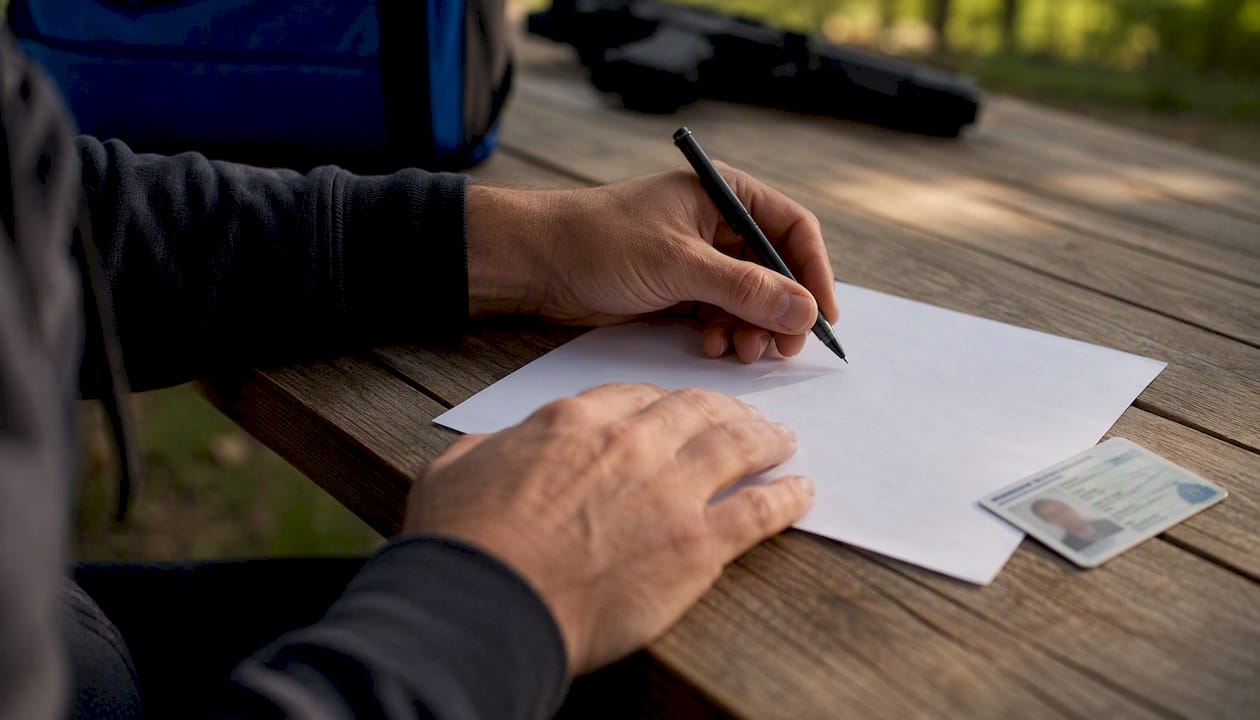
Form 4473 field-by-field breakdown
Per 27 CFR § 478.124, the dealer must verify your ID, record the ID type and number, and retain the completed Form 4473 in their records. Acceptable photo ID includes a state driver’s license, state-issued ID card, or U.S. passport. Military IDs are accepted at many dealers but confirm in advance.
Pro Tip: Providing your Social Security Number on Form 4473 is optional, but doing so significantly reduces the chance of a mistaken-identity delay. If you have a common name or a prior record that was expunged, it is worth including.
What happens during the NICS background check?
Once Form 4473 is complete, the dealer contacts NICS, either through the FBI directly or through a state Point of Contact (POC), depending on the state. The FBI’s FFL quick-reference guide defines a business day for NICS timing as a 24-hour period beginning at 12:01 a.m. the day after the check was initiated, counting only days when state offices are open.
NICS response table
The three-business-day rule means that if a dealer contacts NICS on a Monday and receives no “Denied” by Thursday at 12:01 a.m. (assuming Tuesday, Wednesday, and Thursday are business days with state offices open), the dealer may proceed. Many dealers choose to wait for an explicit “Proceed” regardless, which is their right under ATF best-practices guidance.
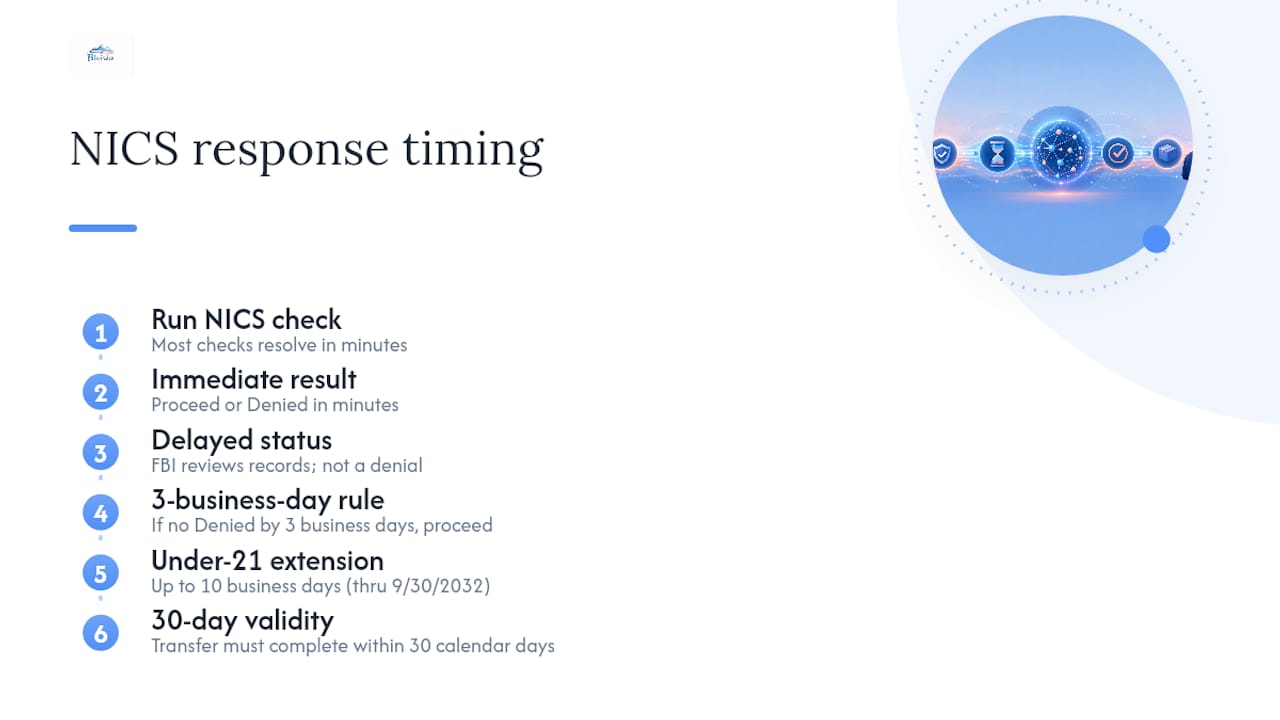
For buyers under 21, 27 CFR § 478.102 extends the investigatory period to up to 10 business days when the check reveals a potentially disqualifying juvenile record. This provision runs through September 30, 2032.
One more timing rule: a single NICS check is valid for 30 calendar days. If you do not complete the transfer within that window, the dealer must run a new check before handing over the firearm.
NICS timing reality check: Most background checks resolve in minutes. A “Delayed” result is not a denial — it means the FBI needs more time to review records. The three-business-day default-proceed exists precisely because the system is not always instantaneous.
Step 5: completing the transfer, paying fees, and dealer recordkeeping
Once NICS returns “Proceed” (or the default-proceed window clears), the final steps move quickly.
At pickup
- Show your government-issued photo ID again (the dealer re-verifies identity at transfer)
- Sign and date the completed Form 4473
- Pay the dealer’s transfer fee (buyer’s responsibility unless otherwise agreed in writing)
- Inspect the firearm for any shipping damage before leaving the counter
What the dealer records and retains
Under 27 CFR § 478.124, the dealer records the NTN or STN on the Form 4473 and retains the form. ATF can inspect these records during a compliance audit, and failure to maintain them accurately is a serious violation. Dealers who falsify or fail to retain Form 4473s face the same license-revocation risk as those who skip background checks entirely.
Who pays what
Federal law does not assign the transfer fee to either party. Industry practice puts it on the buyer. If a seller agrees to reimburse the fee, that is a private arrangement. Document it before the gun ships, not after.
Pro Tip: Ask the dealer if you can photograph the completed Form 4473 for your records. Many will allow it; some will not. Either way, write down the NTN and the date the NICS check was run. That information is your starting point if you ever need to appeal.
Special cases: NFA items, state permits, private sales, and waiting periods
NFA transfers
Suppressors, short-barreled rifles, machine guns, and other National Firearms Act items do not follow the standard Form 4473/NICS retail timeline. NFA transfers require ATF Form 4 approval and a $200 tax stamp, and processing can take months. The NFA buyers guide covers current Form 4 timelines in detail. Do not expect NFA items to move on the same schedule as a standard firearm purchase.
State permit exceptions to NICS
Some states issue firearm purchase permits or licenses that satisfy the federal background-check requirement. When a valid state permit meets the statutory conditions (including, where applicable, a five-year validity window), the dealer may skip the NICS check and rely on the permit instead. This varies by state, so confirm with your dealer whether your permit qualifies before assuming you can bypass NICS.
Private sales
Federal law does not require a background check for private-party transfers between residents of the same state, with some exceptions. Many states, however, require background checks for all transfers regardless of whether a dealer is involved. Check your state’s rules before completing any private sale. For Massachusetts residents, Massachusetts firearm law guidance is a useful starting point for understanding state-specific requirements.
If you’re delayed, denied, or the dealer refuses — what to do next
If your check is delayed
Ask the dealer for the NTN and the exact date the check was initiated. Track the three-business-day window yourself. If you experience repeated delays due to mistaken identity, apply for the FBI’s Voluntary Appeal File (UPIN). A UPIN attaches a unique identifier to your record that helps NICS distinguish you from someone with a similar name or date of birth, reducing future false-positive delays.
If your check is denied
- Ask the dealer for the NTN immediately. They are required to provide it.
- File an appeal with the FBI Appeal Services Team. You have 30 days from the denial to initiate the process.
- Gather supporting documents: court records showing expungements, dispositions, or other relevant history.
- If your state uses a POC instead of the FBI directly, contact the state POC for the denial reason and appeal path.
- Follow up with ATF or a firearms attorney if the appeal is unsuccessful and you believe the denial is erroneous.
If a dealer refuses for discretionary reasons
Dealers have the right to refuse a transfer without providing a detailed explanation, per ATF best-practices guidance. Ask politely for any documentation of the refusal. If you believe the refusal was based on unlawful discrimination, consult a firearms attorney. In most cases, the practical solution is to find another licensed dealer willing to complete the transfer.
Common mistakes that slow or stop transfers
Most transfer delays are avoidable. Here is where buyers and dealers most often go wrong.
Buyer mistakes
- Expired or wrong ID: A driver’s license that expired last month is not acceptable. Bring a current, valid government-issued photo ID.
- Incomplete Form 4473 answers: Every eligibility question requires a direct yes or no. Leaving fields blank stops the process cold.
- Undisclosed records: Outstanding warrants or disqualifying records that trigger a NICS match cannot be hidden. Attempting to conceal them is a federal crime.
- Relying on an expired NICS check: If more than 30 days have passed since the initial check, the dealer must run a new one before transfer.
Seller and FFL mistakes
- Shipping to the wrong state’s FFL (the firearm must go to an FFL in the buyer’s state of residence)
- Failing to confirm the receiving FFL’s willingness to accept the transfer before shipping
- Incorrect serial number on shipping documentation, which creates a mismatch at the receiving dealer’s bound book
Administrative slips
- Failing to record the NTN on Form 4473 after a NICS check
- Mis-entering ID data, which can trigger an erroneous denial that requires an appeal to resolve
- Losing track of the 30-day NICS reliance window and attempting to transfer on an expired check
Pro Tip: Before you leave the counter at pickup, verify that the NTN and the Form 4473 entry date are correctly recorded. A small data-entry error caught in the moment takes seconds to fix. The same error discovered after the fact can require a full appeal.
What Blvista sees customers get wrong — and how to avoid it
Three issues come up repeatedly when customers buy firearms online and need to coordinate a transfer.
First, ID mismatches. A buyer shows up with a name on their ID that doesn’t exactly match what they entered at checkout. The dealer flags it, Form 4473 stalls, and the pickup gets rescheduled. The fix is simple: use your full legal name, exactly as it appears on your government-issued ID, at every step of the purchase.
Second, unclear transfer destination. Buyers sometimes order without confirming a receiving FFL first, then scramble to find one after the gun has already shipped. Blvista’s support team can help coordinate, but it is far cleaner to have the receiving FFL’s name, address, and license number ready before you place the order.
Third, surprise fees. Transfer fees vary by dealer, and buyers occasionally discover at pickup that the fee is higher than expected. Confirming the fee in writing before the seller ships eliminates that friction entirely.
Pro Tip: Before you check out on any online firearm purchase, confirm your receiving FFL’s name, transfer fee, and pickup policy. Screenshot or save the dealer’s confirmation. That one step prevents the three most common transfer headaches.
Blvista makes the FFL transfer process straightforward
When you buy a firearm from Blvista, the transfer process follows a clear path: you place your order, provide your receiving FFL’s information at checkout, and Blvista ships directly to that dealer with full tracking. Fees are disclosed before you complete the purchase, so there are no surprises at pickup.
Here is how it works in practice:
You → Blvista order → Shipment to your FFL → NICS check at dealer → Pickup
Blvista’s team verifies shipping details before dispatch and sends tracking updates so both you and your dealer know when to expect the package. If anything goes sideways in transit, support is available to help coordinate with the carrier and the receiving dealer.
Once you’re ready to pick up, bring your valid government-issued photo ID and any state permit your dealer requires. The dealer handles Form 4473 and the NICS check from there.
Ready to get started? Browse Blvista’s full selection at Blvista and have your receiving FFL’s information ready at checkout. If you reload or want to stock up on supplies after your transfer, Blvista carries Accurate 2460 Rifle Powder and a full range of reloading components alongside its firearm inventory.
Sources
Federal law and ATF guidance govern the FFL transfer process. These primary sources are worth bookmarking:
- ATF industry quick reference and best practices guide
- How Long Does a Gun Background Check Take? Timelines & Delays – LegalClarity
State rules can add waiting periods, universal background-check requirements, or permit mandates on top of these federal rules. Always verify your state’s current requirements with a local attorney or your state’s firearms regulatory agency.
This article provides general information about federal firearms transfer requirements and is not legal advice. Confirm current rules with a qualified firearms attorney or your state’s regulatory authority before completing any transfer.
This article is general information, not a substitute for advice from a qualified lawyer. Consult a qualified legal professional about your own circumstances before acting on anything here.
Recommended
FAQ
A seller ships the firearm to a licensed dealer (FFL) in the buyer’s state. The buyer completes ATF Form 4473, shows government-issued photo ID, and the dealer runs a NICS background check. Once NICS returns “Proceed,” the buyer pays the transfer fee and takes possession.
Shipping typically takes 1–5 business days. The NICS check itself usually clears in minutes, but a “Delayed” result can extend the wait up to 3 business days, or up to 10 business days for buyers under 21 with qualifying juvenile records, per 27 CFR § 478.102. State waiting periods may add additional time.
Yes. Dealers retain discretion to refuse a transfer and are not required to provide a detailed explanation, per ATF best-practices guidance. If refused, ask for any documentation of the refusal and consider contacting another licensed dealer.
The buyer must complete ATF Form 4473, present valid government-issued photo ID, and pass a NICS background check. The firearm must be shipped to an FFL in the buyer’s state of residence for any interstate transfer.
The dealer must refuse the transfer and provide you with the NICS Transaction Number (NTN). You can file an appeal with the FBI Appeal Services Team and submit supporting documents such as court records. If you experience repeated delays from mistaken identity, applying for a Voluntary Appeal File (UPIN) through the FBI can help prevent future false positives.
Was this useful?